

El objetivo de este trabajo ha sido comprender cómo los productos liberados por las praderas de Zostera marina afectan al crecimiento del dinoflagelado tóxico Alexandrium minutum, uno de los microorganismos responsables de las mareas rojas.
El trabajo de investigación ha sido desarrollado como parte de la tesis doctoral de nuestra compañera Alexandra Díaz-Alonso, y en el marco del proyecto BIOTOX, financiado por la Agencia Estatal de Investigación, en colaboración con el Instituto Español de Oceanografía (IEO) y la participación del Instituto de Investigaciones Marinas del Consejo Superior de Investigaciones Científicas (IIM-CSIC).
En este sentido, confirmar el efecto inhibidor de las praderas de Zostera sobre los dinoflagelados tóxicos en condiciones naturales, reforzaría la importancia y necesidad de conservar y proteger estos ecosistemas marinos, por su papel crucial en el control de proliferaciones de organismos nocivos para los humanos.
Experimentos para confirmar el efecto inhibidor de las praderas de Zostera sobre los dinoflagelados tóxicos
Contexto y trabajo realizado
Sabemos que las praderas marinas desempeñan un papel crucial en la salud de los ecosistemas costeros, pero su influencia en la regulación de organismos nocivos para los humanos, como los dinoflagelados tóxicos, ha recibido poca atención hasta el momento. Algunos dinoflagelados son productores de toxinas que pueden causar daños ambientales y económicos significativos.
Basándose en investigaciones previas y en la observación de una menor abundancia de dinoflagelados en áreas con praderas de Zostera, el equipo planteó la hipótesis de que los productos liberados por estas praderas podrían inhibir el crecimiento de los dinoflagelados. Para probar esta hipótesis, se han realizado experimentos en los que se han expuesto cultivos de Alexandrium minutum a los productos liberados por Zostera marina. ¿Cómo lo hemos hecho?
Primero, obtuvimos productos liberados por Zostera, a partir de plantas recopiladas en el área de Cesantes. Se realizó una serie de experimentos para obtener y analizar filtrados del material liberado. Posteriormente, se expusieron cultivos del dinoflagelado a estos productos liberados.
¿Cuáles han sido los resultados?
Los resultados demostraron que los productos liberados por Zostera marina tienen la capacidad de reducir e incluso inhibir el crecimiento de Alexandrium minutum.
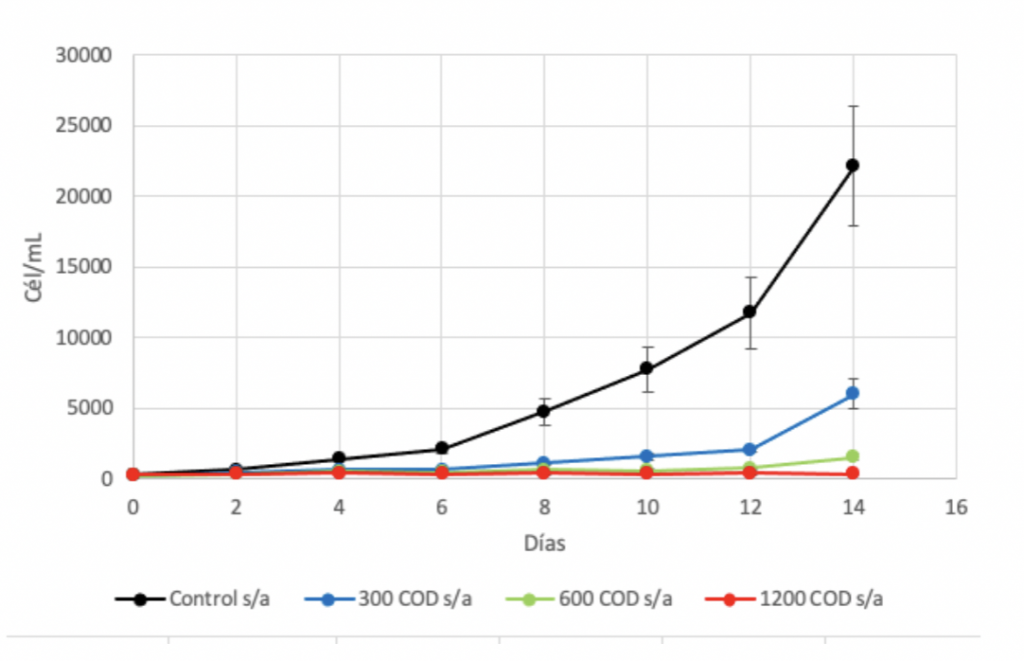
Además, se observó que las bacterias del cultivo aumentaron mucho su abundancia cuando se añadían productos liberados por la Zostera. Por ello, se realizaron experimentos con antibióticos para inactivar las bacterias, que mostraron que la inhibición del crecimiento no se debía a la competencia con bacterias presentes en el entorno, sino que estaba directamente asociada a los productos liberados por la planta.

Aunque este estudio ha arrojado luz sobre el efecto de los productos liberados por Zostera marina sobre los dinoflagelados tóxicos, aún quedan preguntas por responder para comprender si este efecto es consistente en diferentes épocas del año y en diferentes praderas marinas. Además, es crucial identificar la naturaleza química de los compuestos responsables de la inhibición del crecimiento de los dinoflagelados y determinar si este efecto se extiende a otras especies de microalgas tóxicas.
Puedes leer aquí el trabajo completo.
ENGLISH VERSION
New publication on the response of the toxic dinoflagellate Alexandrium minutum to Zostera marina
How the products released by Zostera marina seagrass affect the growth of one of the microorganisms responsible for harmful algal blooms, the toxic dinoflagellate Alexandrium minutum?
This question has been recently unveiled with the research work developed within the PhD of our predoctoral researcher, Alexandra Díaz-Alonso, and in the framework of the BIOTOX project, funded by the State Research Agency, in collaboration with the Spanish Institute of Oceanography (IEO) and the participation of the Institute of Marine Research of the Spanish National Research Council (IIM-CSIC).
Some dinoflagellates are producers of toxins that can cause significant environmental and economic impacts. Here we confirm the inhibitory effect of Zostera seagrasses on toxic dinoflagellates growth under natural conditions, reinforcing the importance of these marine ecosystems. The uncovered key role of Zostera in controlling the proliferation of organisms potentially harmful to humans is another worthful reason for their conservation and protection.
Context and research work
We already know that seagrasses play a central role in the health of coastal ecosystems, but their influence on the control of organisms harmful to humans, such as toxic dinoflagellates, has received little attention so far.
Based on previous knowledge and the fact that there is lower dinoflagellate abundance in areas with Zostera seagrass meadows, the research team wondered if products released by these meadows could inhibit the growth of toxic dinoflagellates. To test this idea, cultures of Alexandrium minutum were exposed to the products released by Zostera marina. How did we do it?
First, we obtained products released by Zostera from plants collected in the Cesantes area (inner Ría de Vigo). After, we acquired and analyzed filtrates of the released material. Lastly, dinoflagellate cultures were exposed to these released products.
The results
The results showed that the products released by Zostera marina have the ability to reduce and even inhibit the growth of Alexandrium minutum.
In addition, it was observed that the bacterial abundance in the culture increased a lot with Zostera release additions. Therefore, we performed experiments where bacteria were inactivated with antibiotics, which shown that dinoflagellates’ growth inhibition was directly associated with the products released by the seagrass and not due to bacterial competition.
Although this study has shed light on the effect of products released by Zostera marina on toxic dinoflagellates, whether this effect is consistent at different times of the year and in different seagrass meadows remains an open question. Furthermore, it is key to identify the chemical nature of the compounds responsible for the inhibition of dinoflagellate growth and to determine whether this effect extends to other toxic microalgae species.
You can read the full paper here.
